Engagement Ring Styles: The Six Settings Worth Knowing in 2026
Vendor pages list ring styles as product filters. This guide explains each style's visual effect, maintenance profile, resale reality, and ideal diamond pairing.
Updated June 2026
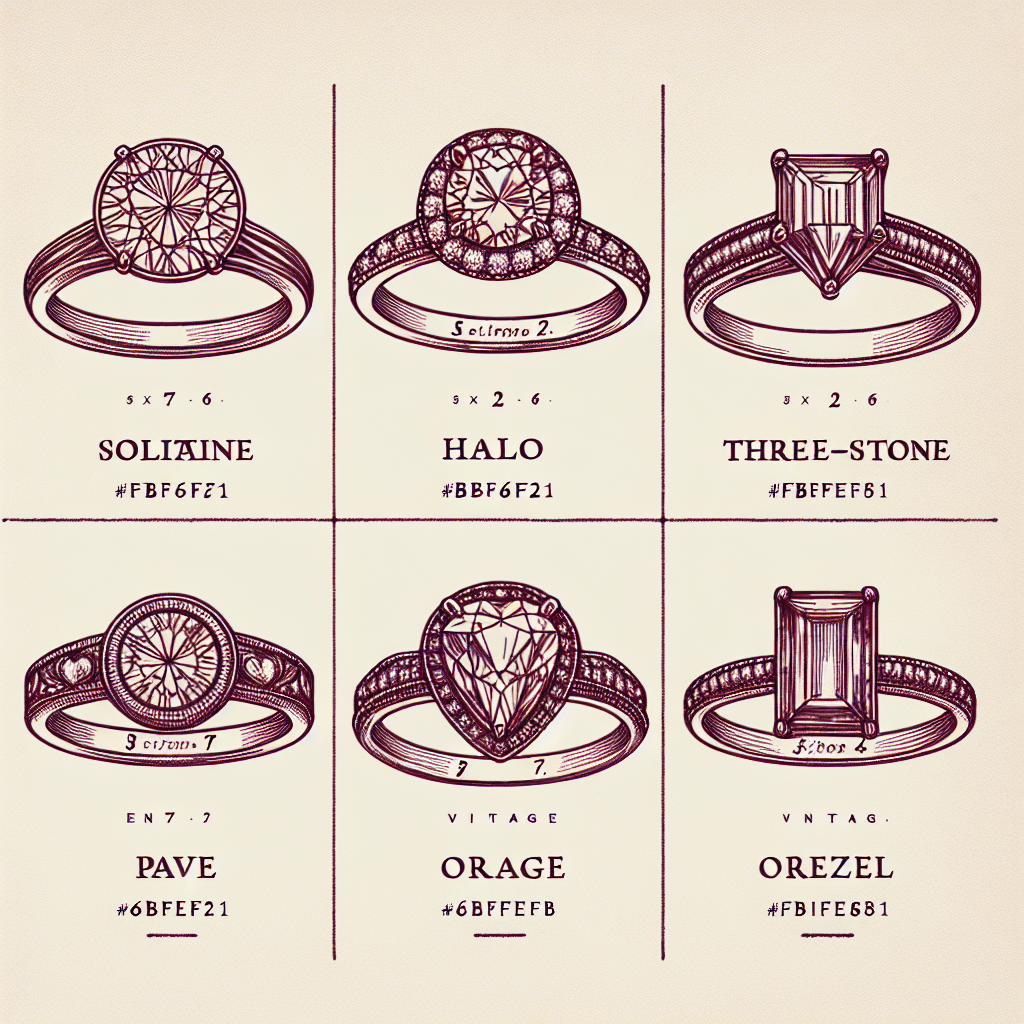
Shape vs setting: "Shape" refers to the diamond outline (round, oval, princess, cushion, emerald, pear, marquise, radiant, Asscher, heart). "Setting" refers to how the stone is held in the band (solitaire, halo, bezel, etc.). Any shape can go in almost any setting. The pairing recommendations below reflect the most visually harmonious and structurally sound combinations.
Solitaire
~40-50% of engagement rings
A single centre stone on a plain or simply tapered band, with no side stones. The solitaire has been the default engagement ring setting since the late 19th century and remains the market leader. Its dominance comes from simplicity: the focus is entirely on the stone, making cut quality more visible and making the stone appear larger relative to the setting.
Advantages
- +Timeless, not trend-dependent
- +Makes the centre stone the focal point
- +Works with any diamond shape
- +Easy to resize up to 2 sizes
- +Pairs easily with most wedding band styles
Considerations
- -Shows dirt easily under the stone
- -Less visually complex
- -Prongs need annual checking
Halo
~20-25% of engagement rings
A centre stone surrounded by a ring of small accent diamonds (or gemstones), usually pavé or micro-pavé set. The halo creates an illusion of a larger, more sparkly centre stone. A 1ct centre stone in a halo setting visually reads like 1.3-1.5ct because the surrounding diamonds blend into the centre stone at normal viewing distance. Double halo settings have two concentric rings of accent stones.
Advantages
- +Centre stone appears significantly larger
- +More sparkle and visual complexity
- +Often 10-15% cheaper than equivalent single-stone look
- +Available in round, cushion, oval, and fancy-shape variations
Considerations
- -Associated with 2000s-2010s fashion
- -Small accent stones can fall out (need periodic inspection)
- -More difficult to resize without disturbing the halo
- -Not everyone wants the extra visual noise
Three-Stone
~10% of engagement rings
A centre stone flanked by two smaller stones on either side, traditionally representing the past, present, and future of a relationship. The most famous contemporary example is Meghan Markle's ring: a cushion-cut diamond flanked by two round stones, though her ring is a specific custom design. Three-stone rings can be symmetric (matching side stones) or asymmetric (different shapes or sizes on each side).
Advantages
- +Symbolic narrative (past, present, future)
- +Often creates an elegant, elongating effect
- +Side stones can be different gemstones for personalisation
- +Strong visual presence without extreme size
Considerations
- -Requires all three stones to be well-matched
- -Setting can be complex and expensive to resize
- -Less versatile for wedding band pairing (often needs a curved contour band)
Pavé
~10% of engagement rings (as primary setting)
Dozens of small diamonds set closely together along the band, often in tiny prongs or beads, so the metal is barely visible and the band itself appears to be paved with diamonds. Pavé (from the French for 'paved') can be a full setting or used as a band accent alongside a solitaire or halo centre stone. Micro-pavé uses even smaller stones, typically under 0.01ct each.
Advantages
- +Maximum sparkle and visual texture
- +Can make a modest ring look rich
- +Works at many price points depending on stone size and count
Considerations
- -Fragile: micro-pavé stones fall out more easily than prong-set stones
- -Cannot be resized easily (stone placement disrupted)
- -More cleaning required to maintain sparkle
- -Higher maintenance cost long-term
Vintage / Art Deco
~8% of engagement rings
A broad category covering rings designed in or inspired by historical periods, most commonly the Edwardian (1900-1910), Art Nouveau (1890-1910), or Art Deco (1920-1935) eras. Characteristics include filigree metalwork, milgrain (beaded metal edge) detail, geometric patterns, coloured accent stones, and old-European or old-mine cut diamonds that have a different light return profile from modern brilliant cuts.
Advantages
- +Unique, not mass-produced
- +Historical craftsmanship often excellent
- +Old-mine and old-European cut diamonds can be purchased from estates at lower per-carat prices than modern equivalents
- +Strong personality and aesthetic distinctiveness
Considerations
- -Estate rings may have prong wear, metal thinning, or stone damage needing professional assessment
- -Modern reproductions vary enormously in quality
- -Harder to resize (intricate metalwork)
- -Style-specific: you have to love the aesthetic unconditionally
Bezel
~5-8% of engagement rings
A continuous metal collar (the bezel) wraps around the entire perimeter of the centre stone, holding it in place. There are no prongs, which means nothing to catch on clothing or hair, and the stone cannot fall out under normal wear. Bezel settings have a distinctly modern, clean look, and are increasingly favoured by people with active lifestyles or jobs that make a raised prong setting impractical.
Advantages
- +Most secure setting: stone cannot fall out
- +No prongs to snag or wear
- +Minimal maintenance required
- +Clean modern aesthetic
- +Protective of fragile stone edges (important for emerald or marquise cuts)
Considerations
- -Metal collar can make the stone appear smaller
- -Less sparkle: prongs allow more light entry than a bezel collar
- -Strong design personality: not to everyone's taste
- -Cannot be resized as easily as a solitaire (bezel must be reformed)